
Each additional setup adds hours. Each re-clamping introduces positioning error. The operator becomes a fixturing specialist, not a machinist. At some point, the bottleneck isn’t the spindle. It’s the number of times a part has to be moved.
A 5 axis CNC router solves this. And the SPC1325-5 axis gantry movement machine solves it for medium-to-large workpieces where stability and work envelope matter as much as axis count.
Not all five-axis machines are the same
There’s a difference between 3+2 positioning and full 5-axis simultaneous machining. In 3+2, the machine tilts the tool to a fixed angle, locks the rotary axes, and runs 3-axis code. It’s useful. But it’s not the same as cutting while all five axes move together.
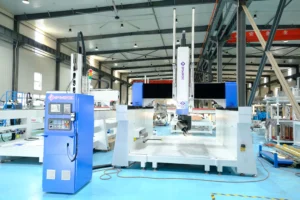
The SPC1325-5 axis CNC router runs simultaneous 5-axis code. That means the tool follows a continuous path across a curved surface while the rotary axes adjust in real time. For mold cavities, automotive styling models, and compound-curve wood patterns, this is the difference between a machined surface and one that needs hand-finishing after the CNC is done.
The controller behind this is the Syntec 610MA-E5 with RTCP function baked in. RTCP—Rotational Tool Center Point compensation—keeps the tool tip on the programmed path regardless of how the rotary axes move. Without it, every tilt shifts the tool tip and requires manual offset math. With it, you program to the part, not to the machine geometry.
Why the HITECO head matters
Rotary axis performance isn’t just about degrees of freedom. It’s about rigidity under load. The SPC1325-5 uses an Italian HITECO 13.5kW 5-axis head. This isn’t a lightweight attachment bolted onto a 3-axis gantry. It’s a production-grade milling head with liquid-cooled spindle, built for continuous cutting across tilt and swivel axes.
On deep mold cavities, the tool may stay engaged for hours at a time. Heat builds up. Vibration accumulates. A head that flexes under these conditions leaves tool marks, degrades surface finish, and shortens tool life. The HITECO head is designed to hold its position and temperature through long cycles. That’s the kind of detail that separates a machine you can run unattended from one you have to babysit.
HSK F63: the tool interface that matches the workload
A 5-axis machine puts different demands on tool holding than a 3-axis router. During simultaneous motion, the tool experiences side loads that ISO and BT tapers weren’t optimized for at high RPM. The SPC1325-5 runs HSK F63 tool holders in an 8-position linear magazine.
HSK F63 provides a dual-contact interface—both the taper and the flange seat simultaneously. This gives better repeatability at high spindle speeds and under the kind of multi-directional forces that 5-axis cutting generates. For roughing passes that remove a lot of material fast, and finishing passes that need a mirror surface, the tool holder matters more than most buyers realize.
Motion control: Yaskawa servo with reducers
Precision at the tool tip starts with motion control at the motor. The SPC1325-5 axis CNC router uses Yaskawa servo motors with precision reducers on all axes. Yaskawa is industrial-grade motion hardware, not entry-level stepper compromises. Fast response, accurate positioning, and the kind of thermal stability that keeps parts consistent from the first workpiece to the last on a long shift.
Laser interferometer calibrated accuracy
The SPC1325-5 positioning accuracy is specified at 0.03mm. That number comes from laser interferometer measurement across the full work envelope, not from a design target or a CAD simulation.
Laser interferometer calibration produces a traceable measurement record. For a mold maker verifying cavity alignment, or an aerospace supplier submitting inspection documentation, that record is what turns a machine specification into auditable proof.
Gantry movement: the structure behind the specs
The SPC1325-5 uses a gantry movement design: the bridge travels on dual-drive synchronized rails over a stationary worktable. This configuration puts the machine’s structural mass around the cutting zone while keeping the workpiece stable.
For large foam molds, composite patterns, or heavy wood forms, this matters. A table-moving design has to accelerate the workpiece mass along with the table. As the part gets bigger, accuracy degrades. Gantry movement decouples part weight from motion accuracy. The workpiece stays put. The spindle does the moving.
Standard work area starts at 1300mm × 2500mm, with options past 2000mm × 4000mm. Z-axis height runs from 800mm up to 3000mm for tall molds and deep forms. The frame itself is welded steel, stress-relieved after fabrication to prevent gradual deformation over years of use.
Where this machine fits
The SPC1325-5 axis gantry movement CNC router does its best work in shops that have outgrown their 3-axis capacity without needing the extreme spans of a ground-track gantry. Typical applications include injection mold cavities, thermoforming tools, automotive interior molds, aerospace composite trimming, boat hull patterns, large foam 3D models, architectural millwork, and solid wood sculptures.
A shop making composite patterns for a boat builder might run expanded polystyrene blocks the size of a small car. The roughing pass removes material fast. The finishing pass needs to leave a surface smooth enough for fiberglass layup without hours of hand sanding. Doing both in one setup, with RTCP active during the finishing pass, is exactly what this machine is for.
When the upgrade makes sense
Not every shop needs a 5 axis machine. If your work is primarily flat panels, nested-based cabinet parts, or single-tool operations, a 3-axis machine like the SPC1325C covers your needs efficiently.
The upgrade signal is usually obvious: you’re turning away complex work, spending more time on setups than on cutting, or competing on price in a crowded 3-axis market while higher-margin 5-axis work goes to other shops. When the bottleneck shifts from spindle speed to setup count, the equipment needs to change.
The SPC1325-5 axis gantry movement CNC router addresses the specific problem of complex part geometry in medium-to-large workpiece sizes. Italian HITECO 13.5kW head, Syntec 610MA-E5 with RTCP, Yaskawa servo drives with reducers, HSK F63 tool interface, and laser-calibrated accuracy—each component selected for shops that can’t afford to lose time on setups or accuracy on finished parts.