
Introduction: Tradition Meets Precision
For decades, small luthier workshops have relied almost entirely on hand tools, craftsmanship, and years of experience to build guitars, violins, ukuleles, and other string instruments. While handcrafting remains the soul of instrument making, more and more independent luthiers are now integrating CNC routers into their workshops—not to replace craftsmanship, but to enhance it.
This shift is not driven by mass production, but by precision, consistency, and creative freedom.
The Core Challenges Faced by Small Luthier Workshops
Before understanding why CNC routers are gaining traction, it’s important to look at the real challenges small workshops face:
- Extreme precision requirements: Fret slots, neck pockets, and bridges allow almost zero tolerance for error.
- Time-consuming repetitive tasks: Rough cutting bodies or neck blanks can consume hours.
- Inconsistent results: Even skilled hands produce slight variations, which affect setup and playability.
- Limited scalability: Custom orders increase workload without proportionally increasing output.
These challenges are not about skill—they are about efficiency and repeatability.
Where CNC Routers Add Value in Luthier Work
Small luthier workshops typically use CNC routers selectively, focusing on critical structural components, not final artistic touches.
1. Body and Neck Rough Cutting
CNC routers excel at:
- Guitar and bass body outlines
- Neck blanks and headstock shapes
- Consistent thickness profiling
This allows luthiers to start with an accurately shaped base, saving hours of rough work.
2. Fretboard Slotting and Inlays
Fret placement accuracy directly affects intonation. CNC routers provide:
- Micron-level fret slot precision
- Perfect spacing for different scale lengths
- Clean cavities for complex inlays
This level of accuracy is difficult to maintain consistently by hand.
3. Neck Pockets and Joint Interfaces
Tight neck joints improve sustain and stability. CNC routers ensure:
- Perfect neck pocket depth
- Repeatable fit across multiple instruments
- Reduced rework and adjustment time
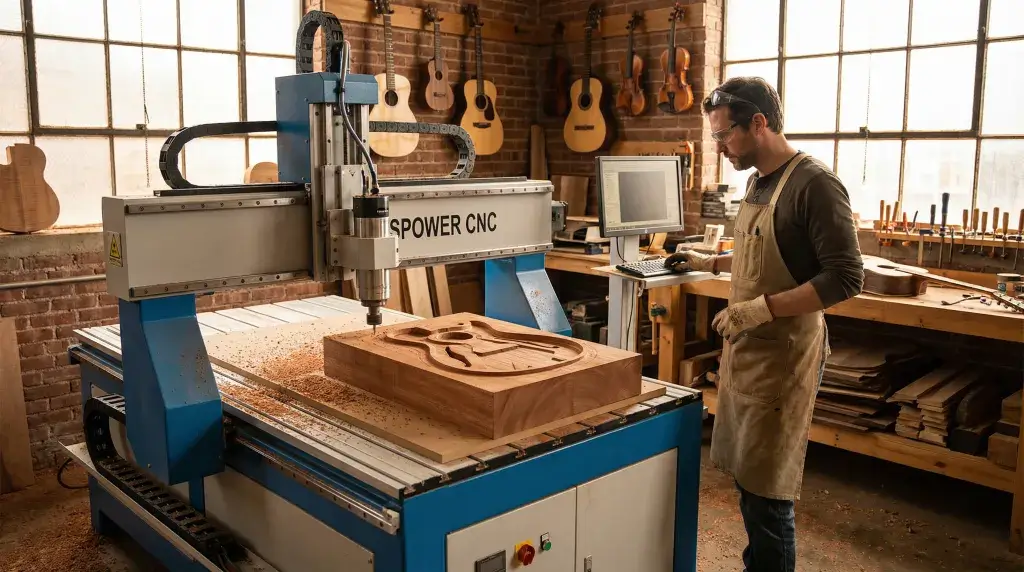
CNC Routers Do Not Replace Craftsmanship—They Protect It
A common misconception is that CNC routers remove the “handmade” value of an instrument. In reality:
- Final shaping, sanding, voicing, and finishing remain manual
- CNC handles geometry; luthiers handle tone and feel
- Less physical strain means more focus on artistry
Many boutique brands openly state that CNC routers allow them to maintain quality while meeting custom demand.
Material Advantages: Working with Premium Tonewoods
High-value tonewoods such as:
- Mahogany
- Maple
- Rosewood
- Ebony
leave little room for mistakes. CNC routers help by:
- Reducing material waste
- Preventing irreversible cutting errors
- Allowing precise grain orientation planning
For small workshops, this directly protects margins.
Why CNC Routers Make Sense for Small-Batch Production
Unlike large factories, small luthier shops benefit from CNC routers in low-volume scenarios:
- Batch sizes of 1–20 instruments
- Custom body shapes and scale lengths
- Frequent design variations
Modern CNC routers are compact, affordable, and flexible enough to fit into limited workshop spaces.
Case Insight: Custom Guitar Builders
Many independent guitar builders now use CNC routers for:
- One-off custom designs
- Limited edition runs
- Replacement parts for repairs
This hybrid workflow—CNC for precision, hands for personality—has become the new standard among modern luthiers.
Conclusion: A Tool for the Next Generation of Luthiers
Small luthier workshops are not turning to CNC routers to become factories. They are doing so to:
- Improve consistency
- Reduce physical workload
- Protect expensive materials
- Expand creative possibilities
In today’s competitive boutique instrument market, CNC routers are no longer a luxury—they are a strategic tool for craftsmanship-driven growth.
For luthiers who value tradition but embrace precision, CNC routers offer the best of both worlds.
Amazing! Its genuinely awesome piece of writing, I have got
much clear idea on the topic of from this post.