
Global Wood Processing Market Trends and How CNC Routers Enhance Efficiency and Quality
The wood processing industry is undergoing transformative growth driven by rising demand for furniture, flooring, cabinetry, and engineered wood products. As the market expands and competition intensifies, manufacturers increasingly adopt automation technologies—especially CNC routers—to improve precision, speed, and product quality.
In this guide, we explore the key global market trends in wood processing and explain why CNC routers are critical to modern wood product manufacturers.
Global Wood Processing Market: Trends and Growth
1. Strong Market Expansion Worldwide
The global woodworking industry has seen substantial growth in recent years. According to industry analyses, the global woodworking industry reached an estimated USD 835.64 billion in 2024 and is projected to grow to USD 888.84 billion in 2025, with continued expansion through 2028 driven by housing demand, furniture production, and green construction initiatives. (From BusinessDojo)
This surge reflects broader trends such as increased consumer spending on home improvements, urbanization, and the popularity of modular and engineered wood products.
2. Rising Demand for Woodworking Machinery and Automation
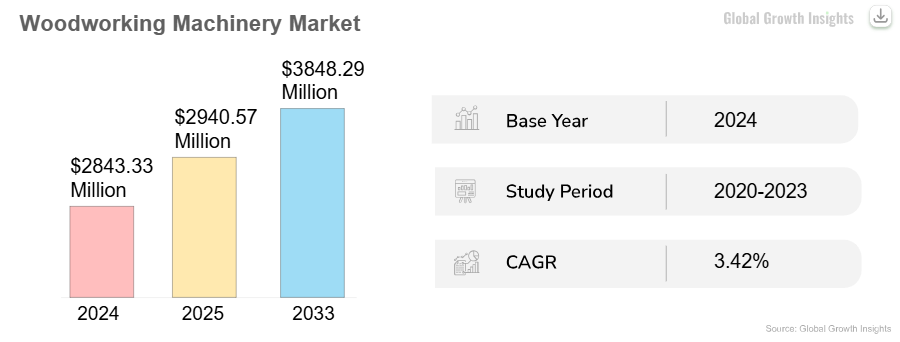
As woodworking demand rises, so does the need for efficient production technologies. The global woodworking machinery market—including saws, planers, sanders, and CNC-enabled systems—is also growing rapidly. One report estimates that the woodworking machinery market will expand from USD 2.84 billion in 2024 to over USD 3.8 billion by 2033, driven by automation and CNC adoption. (From Globe Growth Insights)
Other forecasts show the overall woodworking machine market increasing with a CAGR of 7.52% between 2025 and 2035, with automation and sustainability as core drivers. (From Market Research Future)
3. Increased Use of CNC Technologies
CNC (Computer Numerical Control) technologies are becoming mainstream in wood processing. The woodworking CNC tools market—which includes CNC routers, drillers, and related tooling—is expected to grow steadily, reaching significant market size increases by 2033.
CNC routers alone account for a large share of the woodworking machinery market and are favored for their ability to handle complex cutting, engraving, and shaping operations with high precision. (From Mordor Intelligence)
What Is a CNC Router and Why It Matters in Wood Processing
A CNC router is an automated cutting machine controlled by software to perform precise milling, drilling, cutting, and carving operations. They range from three-axis models for flat cutting to advanced five-axis systems capable of intricate 3D work.
Unlike traditional manual routers, CNC routers follow programmed paths to produce consistent, repeatable, and accurate results—vital for large-scale or customized production.
Key Advantages of CNC Routers in the Wood Processing Industry
1. Enhanced Precision and Consistency
CNC routers eliminate manual variability and deliver consistent precision—often within fractions of a millimeter—across thousands of units. This level of accuracy is crucial for high-quality furniture, cabinets, and engineered wood components.
2. Increased Production Speed
Automated CNC machining dramatically reduces processing time. Whereas manual routing may require skilled labor and multiple setups, CNC routers can execute complex profiles in a single operation. This efficiency is essential as woodworking production scales globally.
3. Better Material Utilization
By optimizing cutting paths and nesting parts, CNC routers reduce material waste and lower production cost—an important consideration amid rising raw material prices and sustainability goals.
4. Support for Complex Designs and Customization
Modern consumer preferences lean toward customized and intricate wood products. CNC routers handle curves, 3D contours, inlays, and detailed designs that are nearly impossible with manual tools.
5. Integration with Digital Workflows
CNC routers integrate seamlessly with CAD/CAM software, ERP systems, and automated factory processes. This digital integration supports advanced production planning, error reduction, and real-time monitoring.
CNC Routers: Necessary for Modern Wood Product Manufacturers
Given the scale of the wood processing market and evolving product demands, CNC routers are no longer optional—they are a necessity for companies seeking competitive advantage.
Meeting Market Demands
With woodworking markets projected to expand steadily, especially in regions such as Asia-Pacific and North America, manufacturers need scalable machining solutions to keep pace with demand.
Workforce Efficiency and Skill Shortages
Labor shortages and rising labor costs are common challenges in woodworking. CNC routers reduce manual intervention, enabling less-skilled operators to achieve high-quality results, while freeing skilled workers to focus on supervision and value-added tasks.
Conclusion
The global wood processing market is showing robust growth fueled by furniture demand, housing renovation, and engineered wood products development. Automation and CNC technologies—especially CNC routers—are pivotal for manufacturers striving to remain competitive by improving speed, precision, and adaptability to complex designs.
As the industry evolves toward higher automation and digital integration, CNC routers will continue to be foundational machines for efficient, quality-driven wood processing operations.